

If you’re planning a timber fence, you probably know roughly what you want already: something private, tidy and strong enough to keep the dog in. What decides whether it still looks right in ten years is less obvious. It comes down to the style you pick for the job, the grade of timber in the ground, the height rules for your boundary, and what’s actually in the quote. Get those four right and a treated pine fence is one of the best-value improvements you can make to a section in South Auckland or Franklin.
The short version
- Pick the style for the job: lapped palings for full privacy, slats or battens for a modern front, pickets for a low front boundary.
- Posts in the ground should be H4 treated pine, or H5 where the post also holds back soil. Rails and palings are H3.2.
- Side and rear boundary fences can usually be 2 m high in Auckland’s residential zones. Front fences are limited to 1.4 m unless part of the fence is see-through.
- A fence up to 2.5 m high doesn’t need a building consent. Pool fences aren’t covered by that exemption.
- To share the cost with your neighbour under the Fencing Act 1978, serve a written fencing notice before work starts.
- Compare quotes line by line. Posts, rails, removing the old fence and gates explain most price gaps.
Pick the style for the job the fence has to do
A fence on a side boundary next to a two-storey neighbour has a different job from a front fence on a busy street. Start with what the fence needs to do, then choose the style.
| Style | Privacy | Look | Suits | Watch for |
|---|---|---|---|---|
| Butted paling | Full at first | The classic Kiwi boundary fence | Side and back boundaries on a budget | Thin gaps open as the timber dries |
| Lapped paling | Full, and stays that way | Same, a little heavier | Boundaries where privacy matters | More palings per metre, so it costs more |
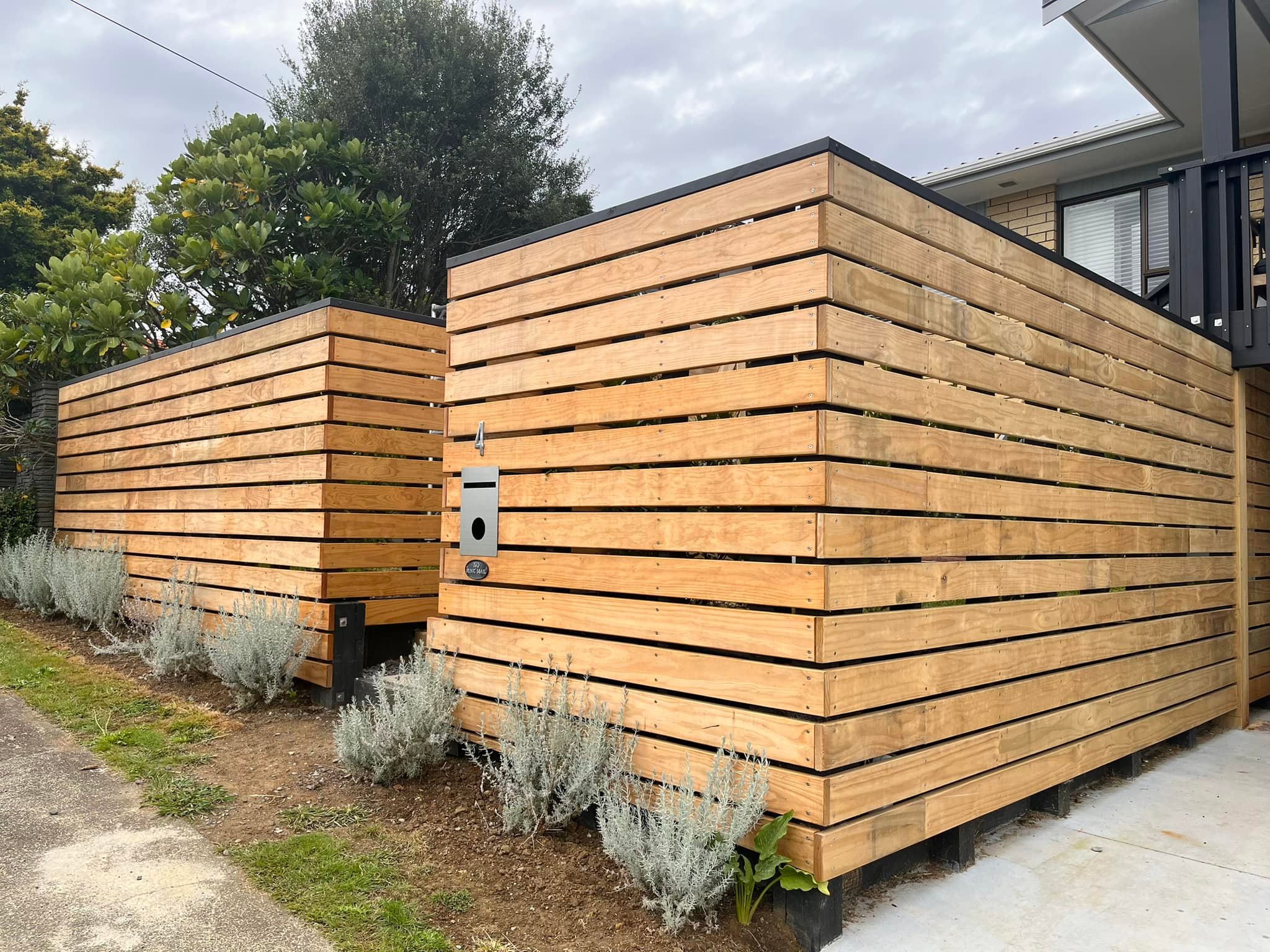
| Horizontal slat | Partial to full, set by the gap | Modern | Front of the house, courtyards, screens | Long slats sag without closer posts |
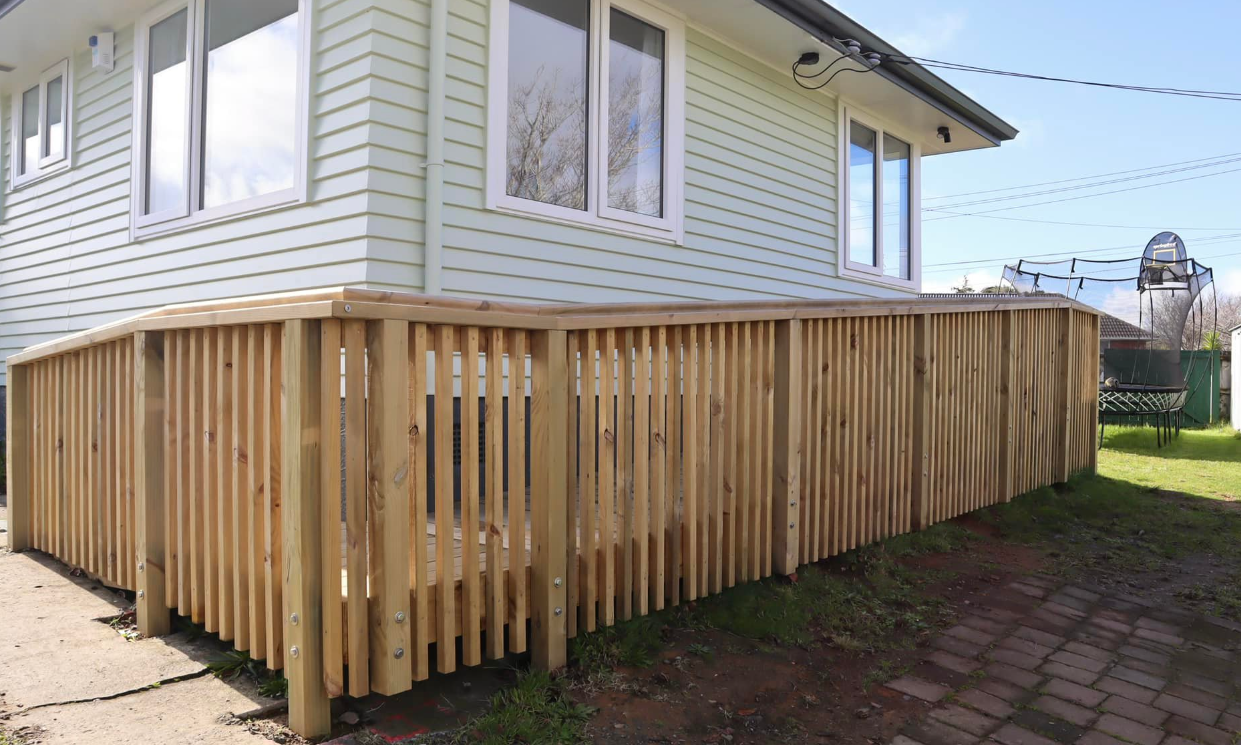
| Vertical batten | Partial | Modern and open | Fronts and windy sites | Less privacy |
| Picket | Low | Traditional | Front boundaries under 1.4 m | Painted pickets need repainting |
Butted palings are usually the cheapest per metre. The catch is that new treated pine shrinks as it dries, so the tight joins you see on day one open into thin gaps over the first summer. If privacy matters, lapped palings, where each one overlaps the next, use more timber but stay closed.
Horizontal slats are the style most people want for the front of the house. They look sharp, but a long slat needs support, so expect posts closer together or a centre stud, or the slats start to sag and cup. Vertical battens let the wind through, which helps on exposed sites.
Posts, rails and palings: what the timber should be
Treated pine in New Zealand is sold in hazard classes, and the wrong class in the wrong place is one of the common reasons a fence fails early.
- Posts in the ground: H4. Where a post also holds back soil, such as on the low side of a slope, H5.
- Rails and palings: H3.2, which is made for timber outdoors and above the ground.
- Kickboards (the board along the bottom that touches the soil): H4, because they sit in ground contact.
For a standard 1.8 m fence, posts are usually concreted in about 600 mm deep and spaced around 2.4 m apart, so one 4.8 m rail spans two bays. Ground conditions change that. A lot of South Auckland sits on clay that stays wet through winter and shrinks in a dry summer, and posts set shallow in clay are the ones that lean after a few years. On soft or exposed ground the holes should go deeper.
New H3.2 pine is often still damp from treatment when it goes up. Let it dry out before you stain or paint it, usually a few weeks in summer and longer in winter, or the coating won’t soak in. After that, a wash and a fresh coat of stain every few years keeps it looking right. Keep garden soil and bark away from the bottom of the palings, because wet soil against timber is where rot starts.
Height rules, consent and your neighbour
In most of Auckland’s residential zones, a fence on a side or rear boundary can be up to 2 m high. Front fences are tighter. The Auckland Unitary Plan limits them to 1.4 m, with room to go to 1.8 m along part of the frontage or where the fence is at least half see-through. Rules vary between zones and some areas have extra controls, so check your property’s zone before you settle on a height.
Building consent is simpler. Under Schedule 1 of the Building Act, a fence up to 2.5 m high doesn’t need a building consent. Pool fences aren’t covered by that exemption.
Sharing the cost with your neighbour
Under the Fencing Act 1978, neighbours generally share the cost of an adequate boundary fence. To ask your neighbour to pay their half, give them a written fencing notice before the work starts. It should set out the boundary, the type of fence, who will build it, the estimated cost and when work will start. Your neighbour then has 21 days to object or suggest something different with a cross-notice. If they don’t respond in that time, they are treated as having agreed.
A chat over the fence first usually saves the paperwork. If you’re not sure exactly where the boundary is, find the survey pegs or get a surveyor out before any post goes in. Moving a finished fence costs far more than checking.
Sloping sections: when a fence turns into a retaining job
Plenty of sections around South Auckland and Franklin aren’t flat, and slopes are where fence jobs most often get complicated.
On a gentle slope you can step the fence, with each bay level and the tops stepping down at the posts, or rake it so the top follows the ground. Stepping looks tidier on an even slope. Raking suits uneven ground because it avoids a triangular gap under each bay.
The bigger issue is soil. If the ground is higher on one side of the boundary, the fence ends up holding that soil back, and palings were never meant to do that. Soil against palings keeps them wet, and its weight slowly pushes the fence over. The fix is a proper retaining wall with the fence on top of it or set just behind.
Two rules matter here. A retaining wall holding back up to 1.5 m of ground generally doesn’t need a building consent, unless it also carries extra load such as a driveway above it. And on side and rear boundaries, the Unitary Plan can count a fence and the wall under it together toward the 2 m limit, so a 1.8 m fence on a 600 mm wall may be over. We build retaining walls as well as fences, so we plan the two together.
Why two quotes for the same fence can look so different
Two quotes for “30 m of 1.8 m paling fence” can be a long way apart, and the cheaper one isn’t always the better deal. The difference is usually in what’s included:
- Removing and taking away the old fence
- Post size and treatment, for example 100 x 100 mm H4 against 125 x 125 mm H5
- Two rails or three on a 1.8 m fence
- Butted or lapped palings
- A capping rail along the top and a kickboard along the bottom
- Gates, hinges and latches
- Digging conditions such as rock, tree roots or buried services
- Access, if every bag of concrete has to go down a narrow side path
Ask each fencer to spell these out, then compare the quotes line by line rather than on the total.
Where we build timber fences
KaPai Builders builds timber fences across South Auckland and Franklin. We’re a registered New Zealand Certified Builder and Pai is a Licensed Building Practitioner. We build other types of fence too.
If your property is outside these areas, say on the North Shore or out west, we recommend Real Fencing. They’re a local fence company that builds timber fences right across Auckland, so you won’t be waiting for someone to travel across town.
The bottom line
Whether a timber fence still stands straight in ten years is mostly decided before the first post goes in. Choose the style for what the fence has to do, check the height rules for your boundary, talk to your neighbour early, and compare quotes on what’s included rather than the total.
If you’re in South Auckland or Franklin, call Pai on 021 0289 0653 or use the Get Free Quote button on this page. We’ll visit, look at the ground and the boundary, and give you a free, no-obligation quote.